

Easter Joy – Moving from death to life
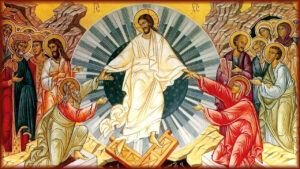
The Easter season reveals to us what is most simple and most true. Before that first Easter we lived in a world that began at birth and ended in death. But through the ensuing twenty-one centuries we have begun to dimly perceive we exist in a dying and rising universe. After the blazing entrance of the Easter Vigil, a kind of quiet clarity seems to meet us where we are. Whether locked in a room with our fears or dejectedly walking away from our disappointments the Risen One confronts us with a hope that confounds a world founded on death and all its works.
Over time, many of us have come to recognize how much of what we see and understand has been shaped not by what was insisted upon, but by what was patiently shown often repeatedly from various perspectives. There is a difference between being told and being led to see and it is a difference that leaves a lasting mark.
For many, the work of Gil Bailie has that character. It never presses itself forward or seeks to win an audience. And yet, it draws people in. Not so much with splashy intention or by design, but because it attends so carefully to what is real. In reading or listening, one often has the sense not of being persuaded, but of noticing something that had been there all along. Remembering that the Cornerstone Forum was once the Florilegia Institute we are reminded of one of Gil’s favorite images, that of the florilegium…
a collection of texts chosen and arranged to acquaint its readers with insights into the human predicament, in this case with the incomparable gift of biblical faith, and the insights into the meaning of life as understood by the theological anthropology on which Catholic faith has drawn. One value of adopting a florilegia approach is that, if successful, it gives the reader a share in the writer’s excitement of discovery while paying respect to the chorus of voices of those to whom he owes a debt of gratitude.
That kind of work has a way of staying with us. Over time it becomes less something we return to, and more something we begin to carry with us, shaping how we see, how we listen, and how we understand.
So, in this season of new even unexpected life, we are filled with a quiet gratitude for what has been given, and for the way it continues to bear fruit, often in ways we only recognize with the passage of time.
~~~~
Gil Bailie continues to persevere in his writing project while contending with health challenges. A short excerpt from a draft chapter may provide a hint of his current work:The Cornerstone Forum remains committed to making this work available on our website, audio podcasts, and Substack venues. We are grateful for all who find this work of value and who help sustain our efforts. Your prayers are greatly appreciated.
When I look back over the last several decades of my life, during which I have explored, and encouraged others to explore, René Girard’s scholarly legacy, I must acknowledge that something of a gap has widened between my work and that of many of those who have also harvested the fruits of Girardian thought. Like Girard himself, I have argued that my friend’s most salient anthropological insights are best appreciated when situated within the Judeo-Christian religious inheritance, as that inheritance is preserved and explicated by the Catholic philosophical and theological tradition. Implicit in much that I have written is the assumption that the kinship between Girard’s most salient insight and his Catholic faith is so essential to his legacy that to ignore it is to compromise the richest and deepest implications of his work.
In his book on Thomas Aquinas, G. K. Chesterton encapsulates an essential tension in Girard’s thought: “when Religion would have maddened men,” Chesterton wrote, “Theology kept them sane.” No one has recognized with more perspicacity than Girard that archaic religion periodically maddened our ancestors by ritually orchestrating a mimetic transference of social animosity onto a single unanimously anathematized victim, whose death or expulsion brought the crisis to an end and restored social solidarity. This is surely the sort of religion that, as Chesterton understood, “maddened men.” Christians, Catholic or otherwise, remain susceptible to his scapegoating “cure” for sin-ravaged societies, large or small. For this reflex is in the social DNA of fallen creatures like ourselves, even if it has been weakened by biblical thought generally and Christian revelation specifically. For that revelation climaxes in the greatest exposé of scapegoating violence of all time: the passion and death of Jesus Christ, forever burned into human memory by the fact of the Resurrection, the incomparable inflection point in human history.
The Cornerstone Forum remains committed to making this work available on our website, audio podcasts, and Substack venues. We are grateful for all who find this work of value and who help sustain our efforts. Your prayers are greatly appreciated.